
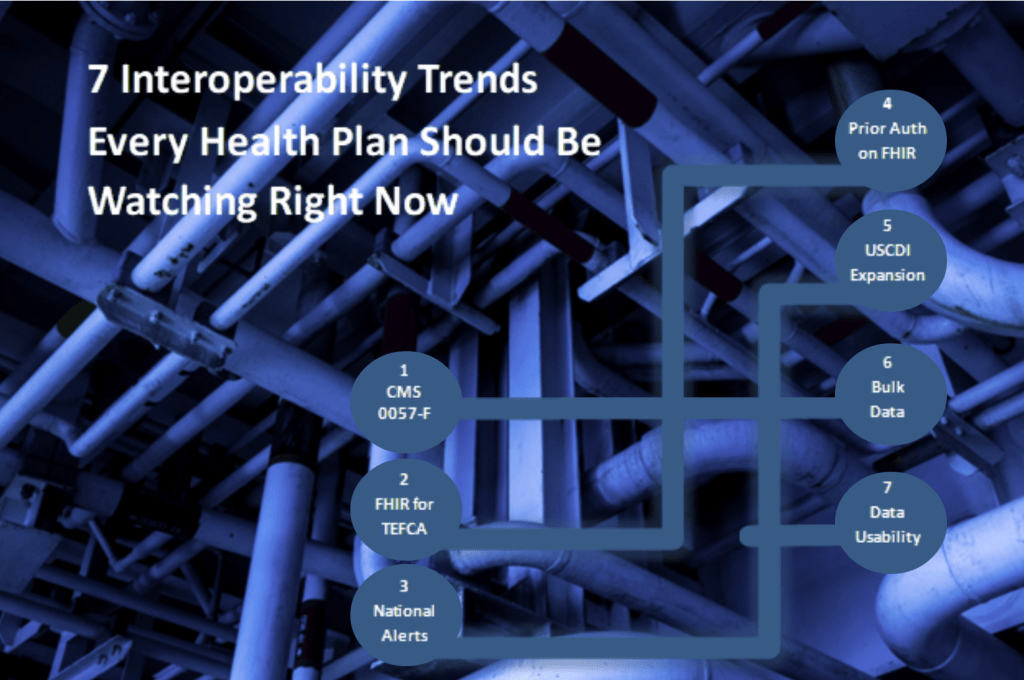
7 Interoperability Trends Every Health Plan Should Be Watching (Right Now)
The last 18 months have moved U.S. healthcare from “talking about data liquidity” to actually turning on the pipes. Below are the seven trends we’re tracking most closely—and what they mean for payers, providers, and patients.
1) CMS’s Interoperability & Prior Authorization rule is real—and the clock is ticking
CMS finalized 0057-F in January 2024 and clarified timelines through 2025: impacted payers must implement certain provisions by January 1, 2026, with most API requirements due by January 1, 2027 (Provider Access API, Prior Authorization API, and enhancements to Patient Access / Payer-to-Payer). These rules explicitly lean on HL7 FHIR to reduce prior auth burden and improve data access.
Why it matters: Even if you’ve met Patient Access (2020), 0057-F adds operationally heavier lifts (end-to-end prior auth transparency, faster decisions, and public reporting). Plans that start mapping workflows to FHIR now—especially PAS/CRD/DTR—will feel a lot less pain in 2026–2027.
2) TEFCA moved from theory to nationwide exchange—and FHIR is next
TEFCA went live with multiple QHINs and has continued to grow connections and volumes through 2025. Common Agreement v2.0 (April 2024) and v2.1 (October 2024) set the policy bedrock. The FHIR Roadmap for TEFCA lays out a staged approach for enabling FHIR-based exchange across QHIN-to-QHIN and end-to-end patterns.
Why it matters: TEFCA is rapidly becoming the default “national backbone” for clinical document exchange. As FHIR enablement lands, expect a step-change from document retrieval to API-driven, discrete data flows that are friendlier to payer analytics and care management.
3) Blue plans are operationalizing real-time clinical signals across regions
The BCBSA Clinical Data Exchange Hub is live, enabling out-of-area real-time hospitalization alerts (i.e., ADT messages). Early adopters are already seeing material volumes—on the order of ~20,000 alerts per month—to drive faster coordination and reduce avoidable readmissions. Payers beyond the Blues are deploying similar ADT feeds at scale.
Why it matters: Timely alerts change outcomes. Event notifications shorten the lag between admission and outreach, which is where plans can bend trend and improve member experience simultaneously.
4) Prior authorization is being rebuilt on FHIR (with X12 where needed)
The Da Vinci PAS IG maps FHIR to X12 for transaction processing and is converging with CRD/DTR to bring prior auth into the clinical workflow in EHRs. CMS 0057-F pushes the ecosystem to expose status, reasons for denial, and decision timelines through APIs—not portals or fax.
Why it matters: Treat this as an operating-model shift, not a single interface build. Plans that pair FHIR APIs with adjudication rules, coverage policies, and clinical criteria will see the biggest gains in turnaround times and provider satisfaction.
5) USCDI keeps expanding—and so will your “minimum necessary” extract
ONC updates USCDI annually (final each July). US Core has already advanced to align with USCDI v4 and is planning for v5, bringing more complete data for care coordination, quality, and SDoH.
Why it matters: Each new USCDI version raises the floor for what must flow. Payers should validate that ingestion, normalization, and matching pipelines can absorb new elements without breaking downstream analytics.
6) Population-scale exports are moving from “nice to have” to “non-negotiable”
The FHIR Bulk Data (Flat FHIR) pattern is the industry’s answer for exporting millions of records without hammering servers. Certification still references v1.0, but active work is expanding Bulk capabilities to US Core/USCDI use cases at scale.
Why it matters: Trend analysis, risk adjustment, and value-based care require longitudinal, member-level datasets—nightly or faster. Bulk Data is how you feed those engines reliably.
7) The center of gravity is shifting from “access” to “usability”
Between TEFCA documents, FHIR APIs, USCDI expansion, and ADT alerts, data volume isn’t the bottleneck anymore – making it usable is. Leaders are investing in identity resolution, clinical normalization, and “signal extraction” (e.g., ingest ADT → trigger care pathways and member outreach).
What smart payers are doing this quarter
- Create 0057-F implementation plan: Inventory APIs (Patient/Provider/P2P/Prior Auth), define CRD/DTR/PAS pilots tied to high-volume services, and lock 2026–2027 milestones.
- Plug into national rails: Join TEFCA via your QHIN strategy and track FHIR enablement windows; align consent and security models early.
- Instrument real-time alerts: Convert HL7 ADTs and other real-time clinical data feeds into measurable interventions (timely care management outreach, readmission reduction, shorter hospital length of stay).
- Harden data usability: Invest in matching, normalization, and quality rules that keep pace with USCDI updates.
- Prepare for population-scale analytics: Stand up Bulk FHIR exports and pipelines to feed trend, quality, and actuarial models.
- Implement 1 – 2 population health use cases: Apply mandated interoperability capabilities to a broad array of applications, e.g., deliver value-based contract attribution rosters to providers (i.e., ATR API), extract supplemental data for HEDIS and risk adjustment (e.g., CDex), and collect self-reported SDoH and member contact data from EHRs.
- Build an AI Foundation: Organize data into a centralized source that is cleansed and normalized as a foundation for your AI Roadmap. (Watch for an Opala blog post coming soon!)
How Opala helps
Opala turns messy, multi-source clinical data into usable intelligence for payers—enabling care coordination and analytics on day one. For Blues, our Blue Clinical Connect integrates with the BCBSA Clinical Data Exchange Hub to deliver high-volume, real-time hospitalization alerts across regions—already proving out tens of thousands of monthly notifications in production. We pair those signals with member-centric data models, so your teams can outreach and support members in personalized and timely ways that bend trend. For all health plans, we lay the FHIR foundations you need for compliance, value-based care, and AI.
Want a deeper dive or a roadmap working session? Let’s connect and align your 2026–2027 plan to the capabilities that move the needle fastest.
We pair those signals with member-centric data models so your teams can act, measure, and improve.
