Advantages of CDex over CCDs: A Comparative Analysis of Clinical Data Exchange Methods
In healthcare today, the need for streamlined, accurate, and timely clinical data exchange has never been greater. The average physician spends nearly two hours on documentation for every one hour of patient care. Clinical data exchange forms the backbone of modern care coordination, reimbursement, quality reporting, and patient safety. The ability to move the right data, to the right place, at the right time directly impacts outcomes and costs. Yet, many providers and payers remain reliant on outdated methods, such as Continuity of Care Documents (CCDs), which often overwhelm users with bulk data and limit real-time usability.
There is a better alternative. Clinical Data Exchange (CDex), a FHIR-based standard, addresses the limitations of CCDs. We will compare the two approaches and highlight the tangible advantages of CDex in meeting today’s interoperability and workflow demands.
Background on CDex and CCDs
What Are CCDs?
The Continuity of Care Document (CCD) is an HL7 CDA-based structured document created to share a patient’s summary record across organizations. CCDs are widely used during transitions of care, referrals, and provider-to-provider information sharing. They contain vital patient details such as diagnoses, medications, allergies, and procedures.
Despite their utility, CCDs have limitations. They are rigid and difficult to tailor to specific use cases. They often include data overload, burying clinicians in unnecessary or redundant information. And because they rely on static document exchange, their usefulness in real-time workflows is limited.
What Is CDex?
CDex (Clinical Data Exchange) is a FHIR-based HL7 Da Vinci Project standard that supports targeted, real-time data sharing through APIs. It facilitates both payer–provider and provider–provider exchanges and is particularly valuable in administrative workflows such as prior authorization and claims adjudication, as well as clinical workflows like quality reporting and care coordination.
Key features of CDex include:
- Granular, targeted data requests instead of entire documents.
- Seamless FHIR API integration with EHRs and payer systems.
- Flexibility to support multiple exchange mechanisms, including push, pull, and subscription models.
Key Advantages of CDex over CCDs
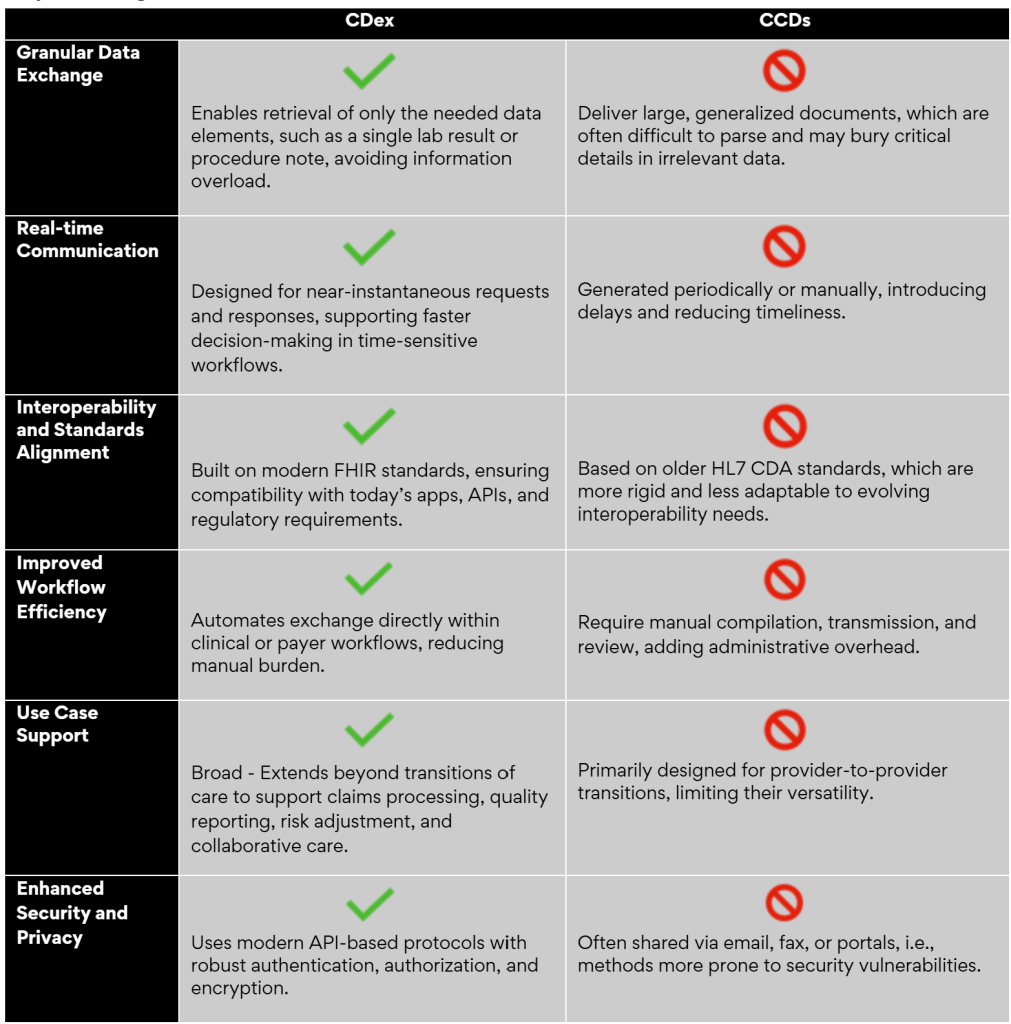
One of the most important advantages of CDex is its ability to enable granular data exchange. Unlike CCDs, which deliver large, generalized documents filled with redundant or irrelevant information, CDex allows users to retrieve only the specific data elements needed.
Another strength is real-time communication. CDex supports near-instantaneous requests and responses, enabling faster decision-making in time-sensitive workflows. CCDs, by contrast, often introduce delays because they are manually compiled or pre-generated.
CDex also shines in interoperability and standards alignment. Built on modern FHIR standards, CDex integrates seamlessly with APIs, applications, and regulatory requirements. CCDs, tied to older CDA standards, lack the flexibility to adapt to new technologies.
In terms of workflow, CDex drives efficiency gains. It automates exchange within payer and provider workflows, reducing manual burden and freeing up resources. CCDs typically require manual effort to compile, transmit, parse, and review.
Another distinction is use case support. CDex extends beyond transitions of care to cover claims processing, quality reporting, risk adjustment, and care coordination. CCDs remain limited to provider-to-provider transitions.
Finally, CDex offers enhanced security and privacy. By leveraging modern API protocols with strong authentication and encryption, CDex protects sensitive data. CCDs, when exchanged through less secure methods such as fax or email, carry greater risks.
At-a-Glance Summary of Advantages
- Granular Data Exchange: Precise, element-level retrieval vs bulky CCD documents.
- Real-Time Communication: Instant requests and responses vs delayed document generation.
- Standards Alignment: FHIR-based and future-ready vs older CDA frameworks.
- Workflow Efficiency: Automated integration vs manual compilation and review.
- Use Case Support: Broad applications including claims, quality, and coordination vs limited transitions of care.
- Security and Privacy: Modern API protocols vs traditional, less secure channels.
Key Advantages of CDex over CCDs
Real-World Applications of CDex
One of the most significant applications of CDex is in payer–provider quality of care collaboration. By automating retrieval of clinical documentation for quality reporting for HEDIS and MA Star ratings, CDex improves accuracy, enables timely patient care, and removes friction between payers and providers.
Another important application is risk coding. CDex simplifies the extraction of data elements from electronic health records and their submission to regulatory bodies. This improves accuracy, reduces friction, and supports compliance with CMS requirements for value-based care programs.
CDex also facilitates provider–provider data sharing. Clinicians can exchange targeted information such as problem lists, diagnostic reports, or discharge summaries, ensuring that the recipient receives only the most relevant details for patient care.
At-a-Glance Summary of Applications
- Payer–Provider Quality of Care Collaboration: Automated retrieval of clinical data for HEDIS, MA Star rating, and value-based contracting.
- Risk Coding: Timely, accurate submissions to support value-based care and CMS compliance.
- Provider–Provider Data Sharing: Targeted exchange of problem lists, diagnostic reports, and discharge summaries.
Challenges and Considerations
Despite its advantages, CDex adoption presents challenges. Adoption barriers remain a hurdle, as organizations accustomed to CCD workflows may resist transitioning, particularly when investment in new infrastructure is required. Interoperability gaps persist. Many legacy systems still rely on CCDs, requiring organizations to implement point solution approaches that bridge traditional and modern standards.
This is where Opala helps organizations transform from a collection of fragmented legacy data systems to a unified, FHIR-native data exchange platform designed for healthcare.
At-a-Glance Summary of Challenges
- Adoption Barriers: Resistance to change and new technology investments.
- Interoperability Gaps: Dependence on legacy CCD systems and history of investment in fragmented solutions.
Strategic Recommendations
Healthcare organizations can overcome these challenges by investing in modern infrastructure. FHIR-enabled platforms unlock the full potential of CDex and prepare systems for future interoperability requirements.
Equally important is collaboration across stakeholders. Payers, providers, and vendors must work together to build trust and transparency through standards-based data exchange.
Organizations should also promote a learning culture. Comprehensive training programs, combined with strong leadership support, ease transitions and encourage people to embrace change.
Finally, hybrid approaches can bridge the gap. By using both CDex and CCDs initially, organizations can maintain continuity while modernizing.
At-a-Glance Summary of Recommendations
- Invest in Modern Infrastructure: Prioritize FHIR-enabled systems.
- Collaborate with Stakeholders: Drive adoption through partnerships.
- Focus on Learning Culture: Prepare teams for ongoing change and adaptability.
- Leverage Hybrid Approaches: Blend CDex and CCDs during transition phases.
Conclusion: Moving Beyond CCDs with Opala
CDex represents a pivotal step forward in clinical data exchange by delivering targeted, real-time information that reduces administrative burden, improves care coordination, and supports regulatory compliance. The benefits over CCDs are clear: efficiency, interoperability, security, and broad workflow integration.
But realizing these benefits requires more than just adopting a new standard. It requires a partner who can bridge the gap between legacy systems and the modern, FHIR-native future.
That’s where Opala comes in. Our platform is purpose-built to:
- Unify fragmented systems into a single, longitudinal view of patient data.
- Enable CDex-driven workflows for prior authorization, quality reporting, risk adjustment, and care coordination.
- Ensure compliance with CMS mandates and evolving interoperability rules.
- Accelerate adoption by combining technical integration with payer–provider collaboration and a learning culture.
Opala empowers payers and providers to operationalize CDex today thereby transforming data exchange from a compliance checkbox into a strategic advantage.
Ready to move beyond CCDs? Partner with Opala to modernize your data exchange, improve outcomes, and reduce costs. Contact us to learn how we can help your organization unlock the full potential of CDex.